Polygon enterprise pilots in 2026
The conversation around Polygon has shifted. What began as a high-throughput layer for speculative trading and gaming has matured into a backbone for regulated enterprise infrastructure. In 2026, the focus is no longer on chasing yield or memecoins; it is on compliance, stability, and real-world asset (RWA) settlement. Financial institutions are moving from observation to active deployment, treating Polygon not as an experiment, but as a production-grade ledger for institutional capital.
This transition is visible in the types of pilots gaining traction. Rather than decentralized exchanges, we are seeing central banks and commercial banks test security tokenization and cross-border payment rails. For example, the Bank of Italy recently launched a pilot on Polygon to explore regulated security token trading. This initiative highlights a critical shift: enterprises are using Polygon’s infrastructure to create compliant environments where tokenized assets can be traded with the same legal rigor as traditional securities, but with the efficiency of blockchain settlement.
The appeal for enterprise finance teams lies in the combination of low cost and regulatory clarity. Polygon’s architecture supports high-throughput applications with sub-cent fees, which drastically lowers the cost of payment processing and improves margins as volume scales. This makes it viable for use cases that were previously economically unfeasible on legacy systems, such as micro-payments, real-time payroll, and high-frequency treasury management. The infrastructure is no longer just about speed; it is about creating a predictable, auditable ledger that satisfies institutional risk requirements.
The market reflects this institutional maturation. As traditional finance integrates with decentralized protocols, the liquidity depth and price stability of underlying assets like POL become critical indicators of network health. The live chart above shows current market sentiment, where enterprise adoption cycles often correlate with increased liquidity and reduced volatility compared to earlier, more speculative phases. For CFOs and treasury managers, this stability is the primary prerequisite for deploying capital at scale.
Stablecoin payments for enterprise
Enterprise finance teams are shifting from traditional correspondent banking rails to stablecoin infrastructure for cross-border B2B payments and treasury management. The primary driver is not speculation, but operational efficiency: settling transactions in seconds rather than days while maintaining fiscal clarity.
Polygon’s infrastructure supports high-throughput applications with sub-cent fees, which directly lowers payment costs and improves margins as businesses scale. For enterprise adoption, the payments infrastructure is only half the equation; the other half is the ability to track and reconcile these transactions with the same rigor as fiat ledgers.
Treasury management is the other major use case. Finance teams use stablecoins to move liquidity across jurisdictions without the friction of foreign exchange delays. Polygon connects businesses to deep stablecoin liquidity, enabling instant settlement and real volume from day one. This allows treasury operations to remain liquid and responsive to market conditions without tying up capital in dormant bank accounts.
Infrastructure and app chains
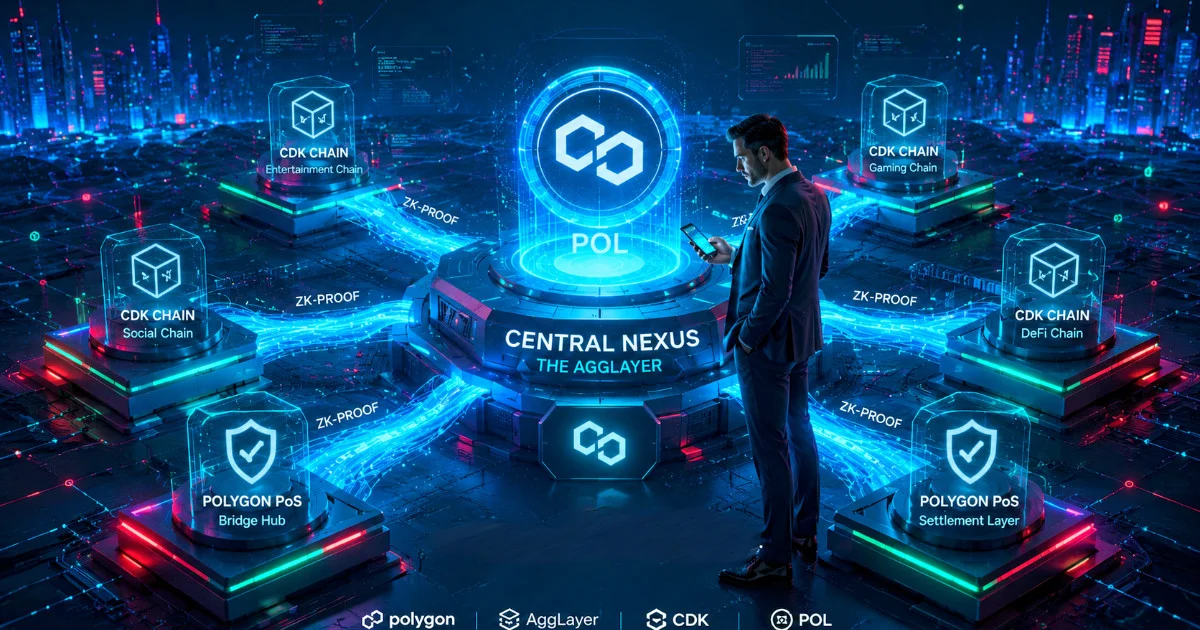
Enterprise pilots don’t run on public testnets. They require dedicated infrastructure that offers isolation, compliance controls, and predictable performance. Polygon addresses this through its App Chain architecture, allowing institutions to spin up sovereign blockchains that share security with the Polygon network while maintaining independent governance and fee structures.
This setup is critical for DeFi applications handling sensitive financial data. By deploying on an App Chain, enterprises can enforce specific regulatory requirements—such as whitelisting participants or restricting certain transaction types—without compromising the broader network’s openness. The result is a hybrid model: the security of a major Layer 2 with the operational flexibility of a private ledger.
To build these chains, Polygon partners with enterprise-grade infrastructure providers like Kaleido. This collaboration enables the creation of carbon-neutral App Chains on the Kaleido Blockchain Business Network. For finance teams, this means leveraging proven DevOps tools and monitoring systems from day one, rather than building infrastructure from scratch. The focus shifts from infrastructure management to application logic and liquidity integration.

The technical backbone supports high-throughput applications with sub-cent fees, lowering payment costs and improving margins as businesses scale. This efficiency is not just about speed; it’s about enabling real-time settlement for complex financial instruments that were previously too costly to process on-chain. For pilots, this means moving from proof-of-concept to production with a clear path to volume.
Regulatory compliance and risk
Enterprise adoption of Polygon DeFi pilots hinges on navigating a complex regulatory environment. Unlike retail speculation, corporate treasury operations require strict adherence to financial laws and internal risk mandates. The recent introduction of frameworks like the GENIUS Act and the US Treasury’s DeFi risk assessment provides a clearer, albeit demanding, path for institutional players.
The GENIUS Act focuses heavily on stablecoin reserves and transparency, directly impacting how payment teams manage liquidity on-chain. For enterprises, this means auditing smart contract interactions and ensuring that stablecoin issuers meet reserve requirements. Polygon’s infrastructure supports these compliance checks through transparent ledger data, allowing treasury teams to verify asset backing in real time without relying on third-party attestations alone. Read more about the GENIUS Act’s implications for enterprise payments.
Simultaneously, the US Department of the Treasury’s April 2023 Illicit Finance Risk Assessment of Decentralized Finance outlines specific vulnerabilities that enterprises must mitigate. This report highlights risks related to anonymity and cross-border transfers, urging organizations to implement robust Know Your Customer (KYC) and Anti-Money Laundering (AML) protocols. Polygon’s modular design allows enterprises to integrate compliance layers at the application or layer-2 level, ensuring that transactions remain traceable and auditable.
To monitor the financial health of these pilots, tracking the underlying asset performance is essential. The following chart provides a technical view of the broader market context, helping treasury teams assess volatility and liquidity conditions before executing large-scale DeFi strategies.
Evaluating Polygon for business
When comparing Polygon’s enterprise infrastructure against traditional finance alternatives, the distinction comes down to two metrics that matter most to CFOs: cost efficiency and settlement speed. Traditional banking rails, particularly SWIFT and correspondent banking networks, are built for stability but often struggle with latency and opaque fee structures. Polygon offers a different architecture, one designed for high-throughput applications with sub-cent fees.
The following table breaks down the operational differences between these two approaches. This comparison focuses on the tangible impact on payment processing and liquidity management.
| Feature | Polygon Enterprise | Traditional Banking (SWIFT) |
|---|---|---|
| Settlement Time | Near-instant (seconds) | 1-3 business days |
| Transaction Cost | Sub-cent per transaction | $15-$50+ per transfer |
| Liquidity Access | Deep stablecoin liquidity pools | Limited to bank balances |
| Fiscal Clarity | On-chain audit trails | Manual reconciliation required |
| Scalability | High-throughput, low marginal cost | Capacity constraints and fees |
For enterprise adoption, the payments infrastructure is only half the equation — fiscal clarity on stablecoin transactions is the other half. Polygon connects businesses to deep stablecoin liquidity, enabling instant settlement and real volume from day one. This lowers payment costs and improves margins as businesses scale, a benefit that becomes increasingly significant with higher transaction volumes.
While traditional systems offer established regulatory frameworks, Polygon’s on-chain nature provides immediate, transparent audit trails. This reduces the administrative burden of reconciliation and offers a clearer view of cash flow in real time. For businesses looking to modernize their treasury operations, the shift from legacy rails to Polygon is less about technology for its own sake and more about operational efficiency.
Common questions about Polygon DeFi
Understanding the mechanics and economic structure of Polygon is essential for enterprise integration. Below are the most frequent inquiries regarding the ecosystem's architecture and its revenue generation model.
No comments yet. Be the first to share your thoughts!